
10 May 2007
The Missing & Unforgotten
There are probably 100-odd people whose lives have at one time been intertwined
with mine. The list of memories is full of double binds and half-hearted
half starts. If you know of any of these people, please let me know. I've
gotten to a point in my life where knowing that others have survived helps
me understand my own continuation. Thus, these are the names of a few of
the lost but not forgotten:
John Bush, Jacksonville Beach, FL 1972
John
owned a place called the Sandpiper Hotel. There was no fancy sign
out front, no neon blinking in the windows. Just two stories of
simple rooms with baths, and two "penthouse" rooms on the roof. I
rented from John from the time the Saratoga got back from the Med
cruise, 1971, until I got out of the USN in 1972. He helped me put
an antenna on the roof so I could play radio. Hauled me out of
trouble a couple times when I got too drunk, this long before I'd
begun renting the room from him.
The last time I was
in Jacksonville Beach (about 20-odd years ago), the Sandpiper was a
parking lot & none of the winos in the liquour store & bar
across the street knew anything about the place, other than it had
caught fire & been invaded by motorcycle bikers.
John Coughlin, RMSN, USN, USS Saratoga
1972
John was one of two guys who ran message boards back and
forth from the MPC on the Sara to the Captain on the bridge. John
was just about as crazy as a person could get away with being, out
there in the middle of the ocean with a couple thousand other
misfits. He's one of many folks from that time I often wonder about.
Hope he was a survivor.
Steve Doyle, Dayton, OH 1970
Faint rumors
once had it that Steve did not survive the 60s. People used to think
we were brothers because I had adopted so many of his mannerisms.
Like eyes almost shut looking out at the world over the bridge of
his nose, head tilted back as if he were on the nod. He & a
girlfriend moved out to Colorado while I was in the
USN.
Joy Eastman, University of Florida, Gainesville
1972
I met Joy when I was hanging around with some friends in
Gainesville. Joy was a much more serious student than I would ever
have been then, and she eventually graduated from UoF with a degree
(and considerable experience) in journalism. She was a good friend.
Her awareness of the play of people in time and space was deeply
affectionate. I miss her friendship. The last time I saw her, she
was sitting in a window seat on a Greyhound bus, headed for
Columbus, Ohio. According to public records available on the
interweb, Joy married in Florida in the mid-70s. She and her
brother & sister are still among the kicking. At least in
print.
Janet Norton, University of Florida, Gainesville
1972
I have no pictures of Janet Norton, whom I met in 1971 via
the friendship of two other people, one of whom passed on in the
middle 70s. Janet's face, her friendly, elfin smirk of a grin, her
honey blond hair and the sparkle of her eyes haunt me almost daily.
Our relationship was silly, in many ways, because I kept my physical
distance from her, pausing once to put my arm around her at a
University of Florida (Gainesville) theatre entrance and then
quickly drawing it away. For some stupid reason, I felt that my
touch might seem threatening to her. She was a good friend
and a soft voice when I listened. I never told her that I
loved her, although my spirit was bouyed by her being part of my
life.
At one time I thought that she had died, basing
that belief on a record in the SSDI for someone by her name. That
particular Janet Norton died 10 July 1993 in Zellwood, Florida. She
would have been 47. My memory of that time, although dim, places the
Janet I knew as being born in very early 50s, which would make her
something like 54 today. Perhaps some day she'll come upon this page
& wonder who I am. As if these pages did not tell . . .
Rich Richardson, RM2, USN, Ramey AFB
1968
Rich was my watch section supervisor for the first
year-and-a-half at Ramey. He & I and a guy named Bruce Gilbert
worked together. It was a weird team. Rich as from New York, street
wise & crazy enough to regard the two white guys in his section
as two visitors from another planet. He went home to New York from
Ramey; I've often wondered what ever happened to him once he got
home. He had talked about getting a government job working in the
same communications area he'd seen in the USN.
Dennis Vorhies, OT2, USN, Ramey AFB 1968
I
think I still owe Dennis money. I first met him when I was up late
one night in the first few weeks I was at Ramey AFB in Puerto Rico.
He came in howling drunk with one of the other guys, staggered into
my room and asked me if I wanted to fight. I told him he probably
didn't either. Later on, after we'd gotten used to each other we'd
go out drinking and end up in deep philosophical discussions about
things I don't remember. He left the NAVFAC for home in Washington
State a few months before I got transfered. I slowed down on my
drinking about that time too. Another survivor, I hope.
Fred Walton, EMSN, USN, Ramey AFB, 1969
Fred
was one of the Puerto Rico gang. Everybody thought that he was
crazy; maybe he was. He had an unruly demeanor that put most folks
off. He drank with one of the other guys whose life was shattered at
Ramey. With Fred the shattering came later . . . which is why he's
listed here and below.
Ellos Que Quedan Solo en Memorias
Those Who Have Gone or Have Chosen to Leave
Every life has a history of discoveries,
joys, tumult & losses. My life is thus no different than any other.
There are places and things that have been such a part of my life that their sudden disappearances have touched me. I usually find out about these now unretrievable moments
by accident, in obits in the newspapers, or news items in radio broadcasts.
 Ben Guild
I had known Ben since the music started.
We'd both been among the first students to open up the history of Wright
State University, back in the early, middle & late 60s,
when our lives seemed so bullet proof and resistant to wear. But
time seems to have worn on Ben more savagely than most of the rest &
he departed this life one autumn afternoon in a recent October. He left
behind a string of friends & colleagues who formed a line around the
block outside the funeral home where his jaded form finally came to rest.
Now all that is left is the memory of his cane on the tiles, his limp &
laughter in the hallways and his almost Fidelista swagger & moderate
improprieties. His passing makes me more aware of the mortality that shadows
us all and of that certain dread of the dark that keeps me alive. Era cabrón,
este hombre, y ahora solo puedo decir que el ánima se fue.
Kathy Alexander
This woman's face is the face that I remember
now, eyes searching my face as we said good-bye many years ago. I met her
first at the Ringgold Street hangout of a local hippie potentate, back
in the late 60s when I was, as Bukowski so wisely noted near the end, "so
unbelievably young."  Kathy
and I shared a space and time that is rivaled in my memory only by two
other
women's places in my life. I last saw her in 1971, when I was home for
a weekend from the USN. We met, we loved and we parted and I carried the
look on her face with me across the Atlantic, around the Mediterranean
and back to Florida. I last talked with her in 1972, when she called (collect)
to a friend. She told me that she loved me and missed me. She said that
she was going to Washington, DC, coming from her digs in California, and
said that she would not be able to stop by and see me then. That was the
last I heard of her until, some years ago, Cindy pointed out a death announcement
in the local paper. That was 15 June, 1985. Kathy died at the age of
38, a victim of the 60s.
Kathy
and I shared a space and time that is rivaled in my memory only by two
other
women's places in my life. I last saw her in 1971, when I was home for
a weekend from the USN. We met, we loved and we parted and I carried the
look on her face with me across the Atlantic, around the Mediterranean
and back to Florida. I last talked with her in 1972, when she called (collect)
to a friend. She told me that she loved me and missed me. She said that
she was going to Washington, DC, coming from her digs in California, and
said that she would not be able to stop by and see me then. That was the
last I heard of her until, some years ago, Cindy pointed out a death announcement
in the local paper. That was 15 June, 1985. Kathy died at the age of
38, a victim of the 60s.
Terry Graham
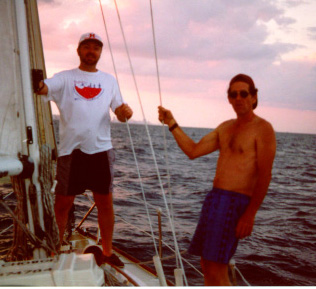 I
learned from Bob Stanton (leaning out of the rigging in the picture here)
some months ago (circa Christmas, 1997) that Terry Graham, with whom I
served time in the military in Puerto Rico, had died some years before.
He was found floating face down in a river somewhere in France, apparently
the victim of foul play. The story of Terry's eventual demise is his own.
Suffice it to say that I owe to Terry a debt, for it was he and Bob who
introduced me to the soul of Janet Norton, mentioned above. Bob and I have survived. That is all there is, except for the sorrow.
I
learned from Bob Stanton (leaning out of the rigging in the picture here)
some months ago (circa Christmas, 1997) that Terry Graham, with whom I
served time in the military in Puerto Rico, had died some years before.
He was found floating face down in a river somewhere in France, apparently
the victim of foul play. The story of Terry's eventual demise is his own.
Suffice it to say that I owe to Terry a debt, for it was he and Bob who
introduced me to the soul of Janet Norton, mentioned above. Bob and I have survived. That is all there is, except for the sorrow.
Jerome Fetsko
Back in 1964 or 1965, when it was just becoming
fashionable for men to grow their hair any longer than an engineer's sideburns,
Jerome Fetsko and I stood talking at a folding table in what was then the
student lounge of the early forms of Wright State University in Dayton,
Ohio. We developed a friendship that included Indian "classical" music
(both Karnatik and Dravidian), burned some reefer together and hung around
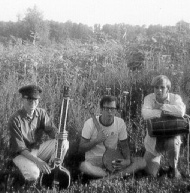 with other hippy friends. We discussed languages, people and places and
came to be the two guys who, if the other had survived and we'd both straightened
out, would have been hell-on-wheels linguists. Jerome spoke Turkish and
Russian and we spent time comparing how language worked, thinking in ways
that only later became popular when Noam Chomsky became famous. The last
time I talked to Jerome was one night around 1973, when he called and begged
me to come over to his house and talk. I declined the invitation, saying
that I was going out to get laid and spend some money in a bar with another
man's wife. I didn't know that he had died until many years later, when
another friend who had played in a band with Jerome, mentioned that he'd
been gone.
with other hippy friends. We discussed languages, people and places and
came to be the two guys who, if the other had survived and we'd both straightened
out, would have been hell-on-wheels linguists. Jerome spoke Turkish and
Russian and we spent time comparing how language worked, thinking in ways
that only later became popular when Noam Chomsky became famous. The last
time I talked to Jerome was one night around 1973, when he called and begged
me to come over to his house and talk. I declined the invitation, saying
that I was going out to get laid and spend some money in a bar with another
man's wife. I didn't know that he had died until many years later, when
another friend who had played in a band with Jerome, mentioned that he'd
been gone.
Fred Walton
There was something strange about Fred Walton,
something that was apparent from the first moment that I met him. He was
one of the many drunks of NavFac Ramey (see above) and considered by some
to be a complete nut case. When he got out of the USN in 1969, he went
home to his parents in Indiana, where his behavior was deemed unredeeming
and where he was subjected to a series of electro-shock therapies that
left him pretty much blotto. I last heard from Fred while I was still in
Puerto Rico. I wrote in response to his description of his hospitalization
with words of encouragement. I thought they were words of encouragement,
at least. His sister felt otherwise and send me a scathing letter telling
me in no uncertain terms to stay the hell out of her brother's shattered
life. This was, of course, long before Vietnam vets were recognized to
have what is today a well known psychopathology of "post-traumatic stress
syndrome." If Fred is still alive, given the technology of medical science,
I would consider the possibilities of divine intervention to be fairly
considerable. Otherwise, as my life has taught me, we have hell enough
here as it is.
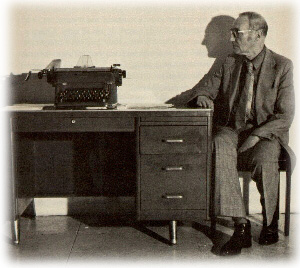 William S. Burroughs, Jr.
I will miss William Burroughs. He was a voice
on paper from my younger times, one of many whose style struck me full
face on. Of all of them, he is the one who taught me most. I remember thinking,
when I was a young sailor, that he had trashed language as time and rewritten
space between the words. There was an incessant carnality in Burroughs'
work that I was reading then. Ticket that Exploded. Nova Express.
A short story in Playboy magazine. Time itself in Mexico, one hundred
years of solitude.
Such solitude is evident in Burroughs' last
words, recorded in his journal and presented in a recent New Yorker
magazine to a witless world as witness for Burroughs' own self-awareness
of the presence of ending.
So now William Burroughs is gone, his voice
silent, his eyes closed to the softness of sunsets and the forecasts of
sunrises, his friends mourning the empty space of his missing energy. And
I easily see in his passing that my story is going on until finally someday,
like my father's story or like Burroughs' story, I will say no more and
become the ultimate hombre invisible.
NAVIGATION
- Welcome
- Introduction
- Family & Friends
- Interests & Distractions
- Philosophicalisms
- Links
- Contact
© Copyright 2007 : The Tagalong Press
Quick Links
My Other Website
W8IJN (Ham Radio) Website
My Blogs
The Mandatory Sentence Blog
Late Night Radio
The Ohio Valley Teratology Net
The Consternation of an Apoplectic Spirit
The Mandatory Sentence Blog
Late Night Radio
The Ohio Valley Teratology Net
The Consternation of an Apoplectic Spirit
View Reading List
